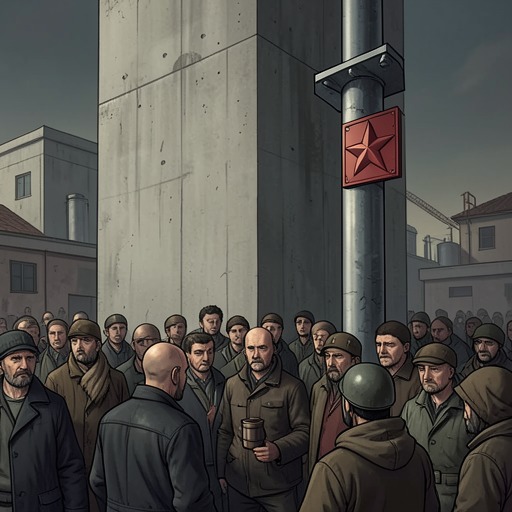
Ideological untruth and conformity
Doctor ZhivagoIdeological untruth and conformity describes the spread of public clichés into private judgment: people lose confidence in their own moral sense, adopt imposed notions, and mistake a social falsehood for a truth about themselves. In Lara's account, that collective pressure enters her marriage to Pavel Antipov and helps propel him toward war and a defiant, ultimately fatal quarrel with history.
From private judgment to public slogans
Lara locates the beginning of the larger breakdown in a loss of trust in individual opinion. People came to regard their own moral sense as obsolete and believed they had to think and live according to notions forced upon everyone. The resulting power of the glittering phrase appeared first in Tsarist language and then in revolutionary language: opposing political vocabularies could serve the same function when they substituted slogans for personal discernment.
She presents this change not as an abstract dispute over political doctrine but as a social epidemic. It spreads through every part of life, so that no sphere remains untouched. The image of infection makes conformity less a single decision than a contagious condition that alters how people speak, judge, and relate to one another.
The infection of domestic life
Lara says that her own home became infected. A relationship that had once been natural and spontaneous turned pompous; conversation acquired a showy, artificial, forced quality. She and Pavel began speaking as if they had to display a particular kind of cleverness about supposedly world-important themes. The contrast matters: the ideological falsehood does not merely govern public speech but changes the texture of intimacy, making a home seem to reproduce the very falseness its occupants might otherwise recognize outside it.
Pavel, Lara recalls, was discerning and exacting with himself, and unusually able to distinguish reality from appearance. Yet the false tone in their marriage led him to the wrong explanation. Instead of recognizing a wider social evil at work, he believed that the unnaturalness came from his own inadequacy—that he was second-rate and insignificant. In Lara's telling, a structural failure of honest speech becomes a private accusation against the self.
Misrecognition and its consequences
That mistaken diagnosis, Lara says, was Pavel's fatal error: he confused the spirit of the times with a private and domestic rejection. He listened to the clichés and official tone around him and interpreted them as evidence that he was a burden. No one had asked him to go to war, but he enlisted because he imagined that his absence would free the family from him. The private decision thus grew from a false account of the marriage, itself produced within a society that had made genuine judgment difficult.
Lara links this first departure to the later form of Pavel's defiance. She describes his offense at events that did not warrant personal offense, his sulking at the course of events, and his quarrel with history as consequences of misdirected, adolescent vanity. He continues trying to get even with history, and the ambition driving that struggle threatens his life. Her account makes no claim that private misunderstanding alone explains the entire political catastrophe; it shows instead how public falsehood can be internalized as personal injury and then acted out as a destructive challenge to history.
Lara's recognition of the tragedy
The concept is conveyed through Lara's retrospective explanation to Yurii Andreievich Zhivago, rather than through an impersonal statement of theory. She moves from social breakdown to the altered tone of her home, then from that intimate change to Pavel's mistaken self-understanding and departure. The sequence reveals the scale of the damage: slogans become habits of speech, habits distort a marriage, and the distortion helps set a life on a fatal course.
Her final appeal to save Pavel gives the analysis its personal urgency. The account is not simply a denunciation of political language; it is an attempt to make sense of the man she loves and the forces that have turned his sensitivity to falsehood into a false reading of his own worth. Its central warning is that when people surrender their own moral judgment to imposed formulas, public untruth can pass as private truth—with consequences that reach far beyond speech.